At the 2025 American Academy of Dental Sleep Medicine (AADSM) Annual Meeting in New Orleans, a group of IAOS-affiliated dentists stood out by doing more than participating—they elevated the conversation. Through case studies, clinical protocols, and diagnostic advancements, these thought leaders presented posters illustrating further how Restfull Powered by IAOS-trained dentists are not just delivering care—they are defining the future of dental sleep medicine (DSM).
We are proud to recognize the work of Dr. Charles Tozzer, Dr. Omar Bajwa, Dr. Michael Murray, and Dr. Suzanne Thai for presenting peer-reviewed research that exemplifies the IAOS standard of clinical and operational excellence.
As DSM becomes increasingly vital in managing chronic health conditions like obstructive sleep apnea (OSA), these IAOS contributors reinforced what we have long believed: modern DSM practices must be faster, more precise, and more accessible—without compromising patient outcomes. Each of these studies explores a key friction point in the field: speed to treatment, quality of device fabrication, and cost-effective care in managed systems. Together, they form a powerful triad of innovation.
Editorial: Driving Innovation in Sleep Dentistry
Reducing Time-to-Treatment in Oral Appliance Therapy
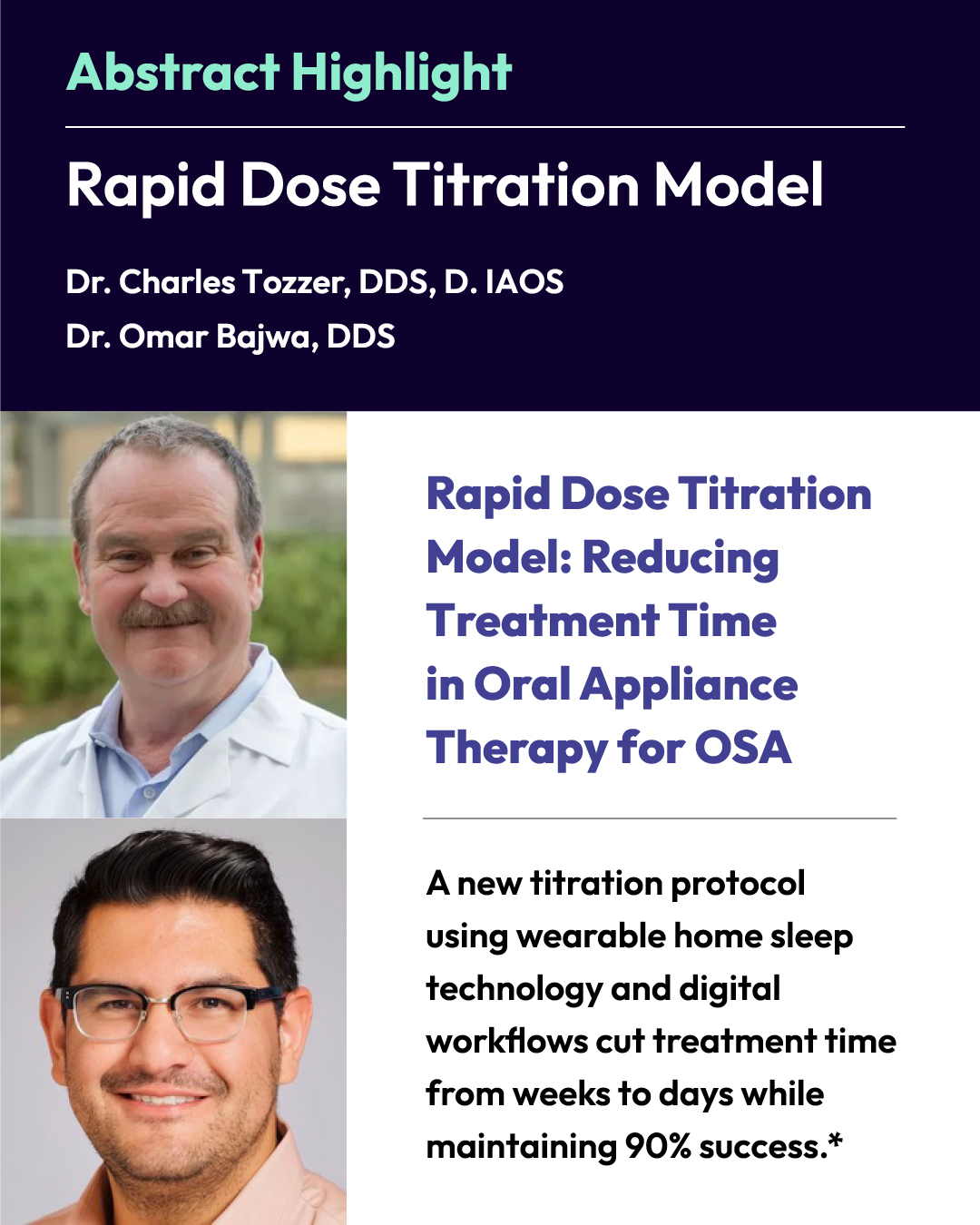
In traditional dental sleep workflows, patients can wait up to two months before their appliance reaches the ideal therapeutic position. That delay costs time, sleep, and—ultimately—patient adherence. Dr. Charles Tozzer and Dr. Omar Bajwa sought to eliminate that gap through a new rapid titration model that blends digital workflow, remote monitoring, and patient-led adjustments.* By combining home sleep testing (HST) rings with clear titration instructions and digital appliance fabrication, their protocol achieved 90% success with an average time-to-dose of just 27 days. Most critically, no adverse effects were observed, highlighting how efficient doesn’t have to mean risky.
This approach reinforces what Restfull has built into its architecture: a systems-based model that favors speed, predictability, and patient-led engagement.
Improving Precision in Device Fabrication
If titration is the road to therapeutic efficacy, bite registration is the on-ramp—and when it’s off, everything downstream is affected. Dr. Michael Murray tackled this with a new digital protocol to verify construction bite midline position in real time.† Using 3D scan data and occlusion software, Murray found that 70% of patients initially presented with a skewed bite. Instead of discovering that after device fabrication, his workflow caught it early, allowing for immediate correction. The result: fewer TMJ complications, greater patient comfort, and improved device success.
Precision at the foundational stage of treatment is often overlooked, but this study proves it is just as important as post-delivery titration or efficacy testing.

Cost-Effective, Patient-Centric Care in Managed Systems
Dr. Tozzer and Samantha Rogan presented a compelling case study focused not on tools or techniques, but on the decision-making framework used to guide patients through complex care options.‡ By comparing CPAP, hypoglossal nerve stimulation (HNS), and oral appliance therapy, the study made a powerful case for DSM’s unique position in the value-based care ecosystem. Oral appliances were not only significantly less expensive than surgical alternatives (HNS: ~$40,000; CPAP: ~$5,000 over 5 years) but also showed the highest adherence (83%) and superior efficacy for many patients.
In one featured case, a patient who failed both CPAP and HNS due to discomfort and lack of improvement ultimately succeeded with an oral appliance, bringing her AHI down from 34 to 9 and oxygenation levels back into safe territory.
The takeaway is clear: DSM can and should be a first-line treatment, not a fallback plan. The Restfull platform is uniquely positioned to support that shift by giving providers the tools to educate, triage, and treat in a system that respects both clinical outcomes and healthcare economics while prioritizing the process required to bill & receive prompt reimbursement from medical payors for this life-alterning treatment.

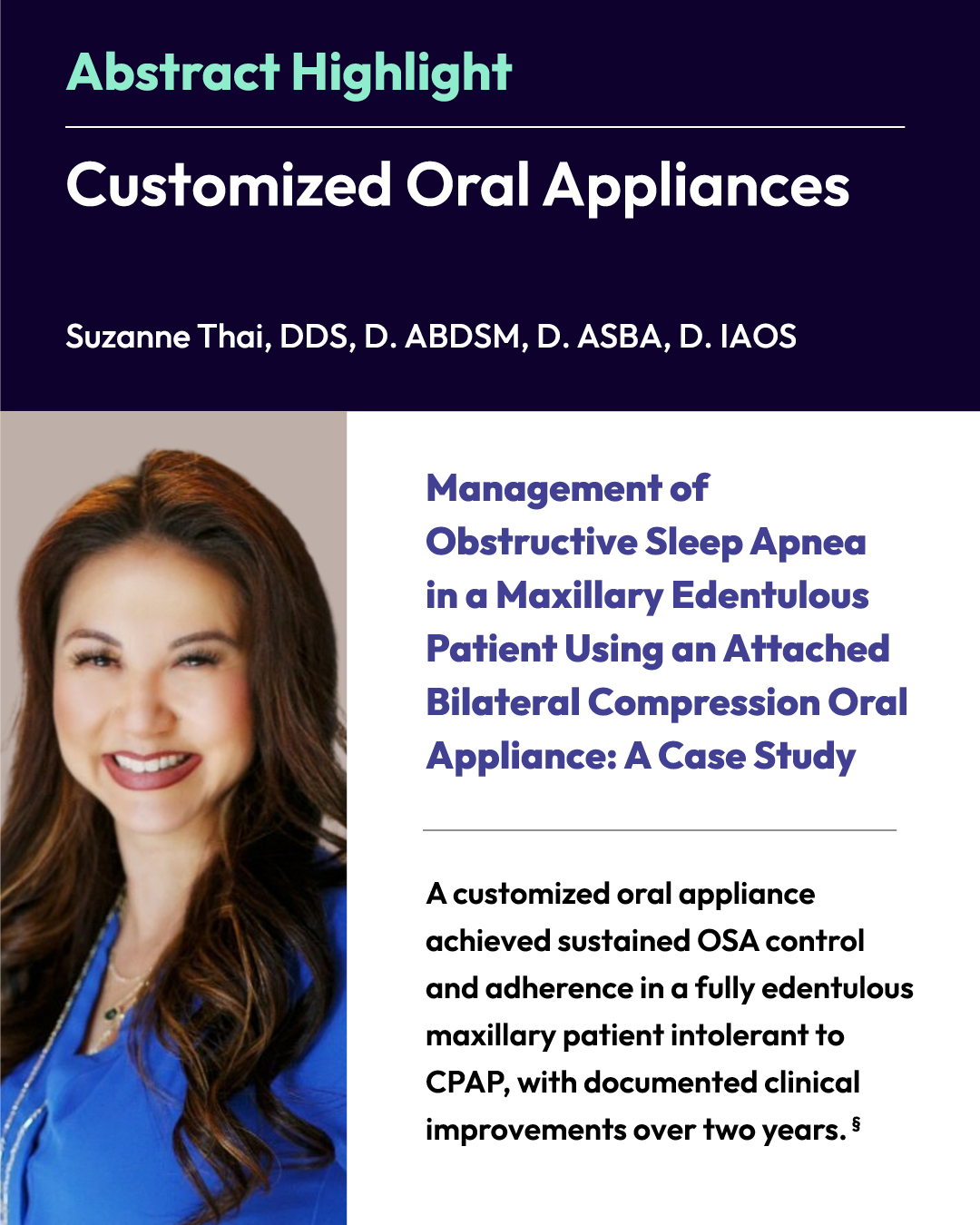
Management of Obstructive Sleep Apnea in a Maxillary Edentulous Patient Using an Attached Bilateral Compression Oral Appliance: A Case Study
This case study illustrates the long-term success of oral appliance therapy in a patient with a completely edentulous maxilla and intact mandibular dentition—historically considered a relative contraindication for oral appliance use. The patient, who had failed CPAP due to claustrophobia and poor tolerance, was successfully treated with a custom-attached bilateral compression oral appliance lined with soft material for comfort and stability.
Despite anatomical challenges, the patient adapted immediately. Digital scans and a custom wax rim were used to establish vertical dimension and aid fabrication. An anterior discluder guided mandibular positioning, and favorable lip anatomy allowed for reliable lip seal even at higher vertical dimensions.
Outcomes over 2 years included:
- AHI reduction from 20 to 4.5
- O₂ nadir improvement from 85% to 92%
- Snoring resolution, elimination of nighttime awakenings, and
- Sustained weight loss (25 lbs initially, 50 lbs at 2-year follow-up)
The case challenges the assumption that maxillary edentulism precludes oral appliance therapy and emphasizes the importance of retention, comfort, and education in driving long-term adherence.
The Bigger Picture: A Standard Worth Sharing
These studies didn’t just add to the literature—they modeled a higher standard of DSM delivery. And while each was presented under the auspices of the American Academy of Dental Sleep Medicine—a vital institution advancing clinical scholarship in the field—it is the vision, discipline, and execution of IAOS-trained providers that turned insight into innovation.
This is the promise of Restfull Powered by IAOS: to combine science, systems, and service into a complete DSM delivery model that helps dentists thrive while patients finally get the sleep they need.
To the doctors who contributed their work to AADSM & AASM 2025—we thank you. You made all of us proud.

References
* Tozzer C, Bajwa O. Rapid Dose Titration Model: Reducing Treatment Time in Oral Appliance Therapy for OSA. Poster presented at: American Academy of Dental Sleep Medicine Annual Meeting; May 2025; New Orleans, LA. Also presented at: American Academy of Sleep Medicine (SLEEP) Annual Meeting; June 2025; Seattle, WA. https://aadsm.org/journal/abstracts_issue_122.php
† Murray MJ. A Digital Protocol to Identify and Prevent Construction Bite Errors. Poster presented at: American Academy of Dental Sleep Medicine Annual Meeting; May 2025; New Orleans, LA. https://aadsm.org/journal/abstracts_issue_122.php
‡ Tozzer C, Rogan S. Minimally Invasive Managed Care: A New Way to Triage Treatment in OSA. Poster presented at: American Academy of Dental Sleep Medicine Annual Meeting; May 2025; New Orleans, LA. https://aadsm.org/journal/abstracts_issue_122.php
§ Thai, Suzanne DDS, D. ABDSM, D. ASBA, D. IAOS. Management of Obstructive Sleep Apnea in a Maxillary Edentulous Patient Using an Attached Bilateral Compression Oral Appliance: A Case Study. Poster presented at: American Academy of Dental Sleep Medicine Annual Meeting; May 2025; New Orleans, LA.